Personal Alert Victoria (PAV) offers eligible Victorians a free personal monitoring and emergency response service. This important service is funded by the Victorian Government and helps people continue to live independently at home, safe in the knowledge that help is only a button press away.
If you or someone you know is frail, elderly and isolated or who is living with a disability, you may like to consider applying for the PAV program.
What does the PAV service involve?
The PAV service responds to calls for assistance 24 hours per day.
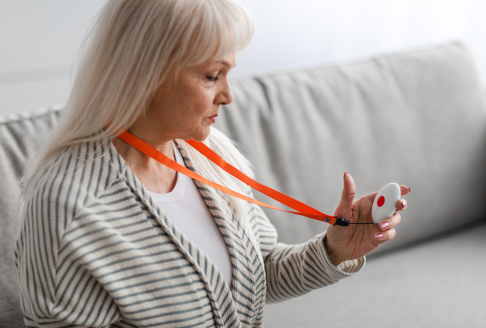
Clients wear a pendant around their neck or wrist which is designed with a button that, when pressed, dials the PAV hotline connecting the caller with trained staff ready to provide assistance. For example, if you fall or suddenly feel unwell, you can press the button and be connected with someone who can speak with you through the pendant.
PAV hotline staff will talk with you to determine whether a call should be placed with emergency services, one of your nominated contacts (usually family members, friends or neighbours) or whether you simply require some reassurance about your situation (in the event of a non-urgent issue).
How does my pendant connect me to the PAV hotline?
A receiver unit sits next to your telephone and is plugged into your telephone line. When it receives an alert from your pendant (after you have pressed the button), the receiver unit automatically dials the PAV hotline.
Who is eligible for the PAV service?
Eligibility is determined via an assessment conducted in your own home.
There are two sets of eligibility criteria to meet – Part A and Part B:
Part A:
You must meet all three conditions set out below –
- Daily monitoring – you consent to daily monitoring.
- Wearable pendant – you are capable of using and willing to wear the PAV pendant at all times.
- Living situation – you live alone OR are alone for most of the day or evening OR live with a person who would be unable to get to the phone in an emergency (or is unable to use the phone).
Part B:
You must meet two of these criteria –
- You have had at least one fall that needed medical attention in the previous six months or be at risk of falls.
- You suffer from a major medical or chronic condition that puts you at risk of medical emergencies or has some ongoing effect on your health or wellbeing.
- You are taking six or more different medications on a permanent basis that are prescribed by your doctor / medical specialist.
Who conducts my eligibility assessment for PAV?
Eligibility assessments for the PAV service are usually conducted by your local council, community health service, aged care assessment service, district nursing service and some publicly funded community rehabilitation services.
You can either contact your local service provider directly (for example, by enquiring with your local council’s aged care program) or be referred to an assessment service by your doctor or local community health service.
It’s worth noting that there may be a waiting period involved until a PAV unit becomes available for installation at your home.
For more detailed information on the PAV program, please refer to the PAV program and service guidelines provided by the Victorian Department of Health.
Community news
-

BaptistCare team member recognised at Tasmanian Disability Awards
Jonty Roberts has been recognised for making a meaningful difference in the community, taking home the Local Area Coordinator of the Year award at the 2026 Tasmanian Disability Awards.
- 24 Sep 2026
-

At Peninsula View, a retirement community sitting proudly at the gateway of the Mornington Peninsula, that quality detailing is no accident. Fifty-seven new two and three-bedroom villas are currently under construction, adding to the existing community - the result of years of design thinking from an architectural team with a long history with building retirement communities across Australia’s east coast.
- 07 Sep 2026